Top-Innovator 2026 – top100.de

DLC coating of seals

  • Home
  • Sealing Technology
  • DLC coating of seals
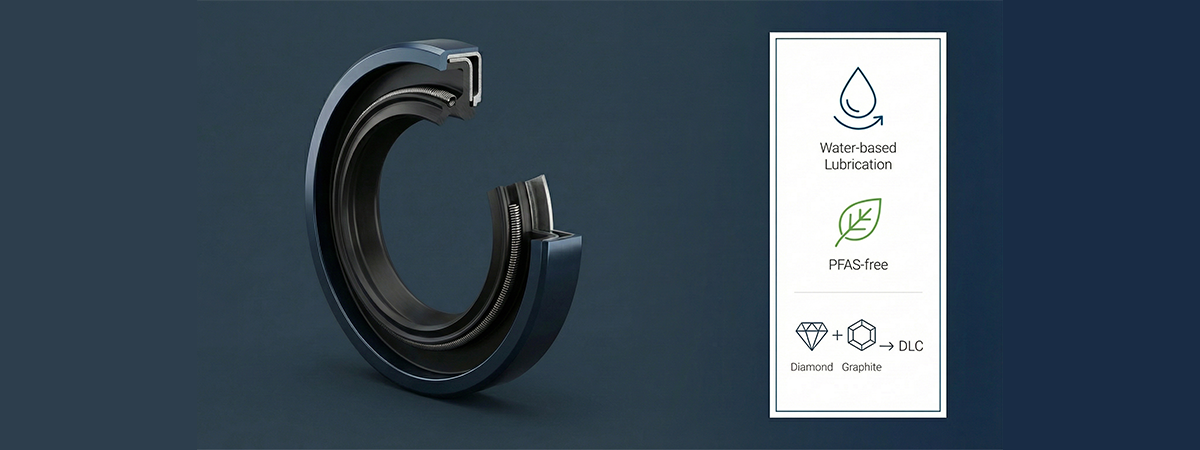
  • PTFE and FKM seals are standard in the industry. Both materials contain PFAS (per- and polyfluoroalkyl substances), which are increasingly subject to regulation under the European REACH Regulation. Anyone planning systems or procuring seals today faces a specific question: Which alternatives offer comparable performance without relying on materials or lubricants containing PFAS?

    Together with the Fraunhofer Institute for Mechanics of Materials IWM, we are testing a technology that makes exactly that possible: DLC coating of elastomers.

    What is DLC?

    DLC stands for diamond-like carbon. In a plasma vacuum process, a thin layer of diamond-like carbon is applied to elastomers. The high-rate DLC coating developed at Fraunhofer IWM forms a brain-like microstructure on the elastomer surface. This structure combines two properties: it reduces friction and protects the base material from wear, even under dynamic loads.

    Fundamental research: friction and adhesion

    In a ball-on-disc test against steel, the DLC coating on HNBR reduced friction by 45% compared to uncoated material. When combined with prior laser texturing, the coefficient of friction dropped by as much as 56%. No measurable wear was observed on the DLC-coated samples.

    The coating’s adhesion was tested using a scratch test with a diamond needle on five different substrates: EPDM, PE1000, NBR, PTFE, and HPU (hydrolysis-resistant PU). SEM images at 300x magnification showed no significant chipping on any of the substrates. The DLC coating also adheres reliably to widely varying elastomers.
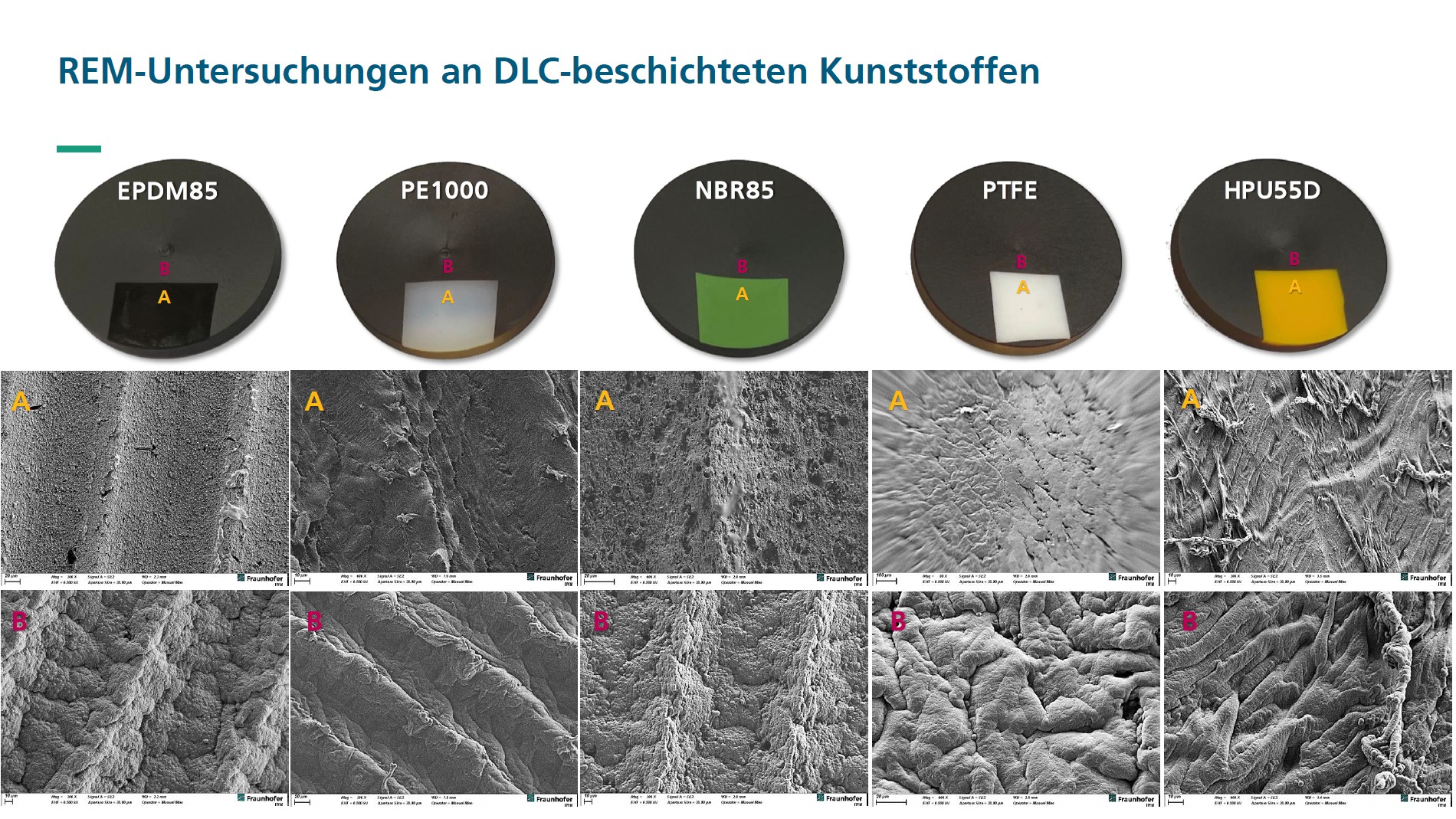
    REM-Untersuchungen an DLC-beschichteten Kunststoffen

    In addition to the ball-on-disc tests, ring-on-disc tests against aluminum were conducted, in which the contact pressure was gradually increased until failure occurred. DLC-coated elastomers withstood significantly higher pressures than uncoated ones. SEM analyses after the test confirmed this finding: In the uncoated NBR, the machining grooves on the surface were completely smoothed out, with significant adhesive wear. In the DLC-coated test specimen, however, the coating was still intact in the valleys of the grooves. Only at the peaks was slight adhesion evident. The coating acts as a protective layer that shields the underlying material from abrasion.

    Water-based lubrication instead of oil

    One particularly significant finding concerns lubrication. Under normal conditions, elastomers do not lubricate well with water; they require oil or PFAS-containing lubricants. The DLC coating fundamentally changes this.

    In tribological testing, DLC-coated HNBR achieved the same coefficient of friction as oil-lubricated systems when using a water-glycerin mixture (30% water, 70% glycerin) at a certain sliding speed. This opens up a new solution for applications where both PFAS-containing materials and oil lubrication must be eliminated.
    Another finding from the dry-running tests: At low sliding speeds, the friction of dry-running DLC-HNBR was even lower than that of lubricated systems. This is because lubricants themselves generate a certain amount of flow resistance, which becomes significant at low speeds. Only above a certain threshold do lubricated systems have an advantage.

    From the lab to the test bench

    Fundamental research reveal trends, but whether a seal actually works can only be determined under realistic conditions. That is why, in collaboration with Fraunhofer IWM, we have developed a rotational test bench that tests sealing lips at speeds of up to 8,000 rpm and under continuous dynamic loading. The test measures friction torque, sliding speed, leakage rate, and temperature. A rotary seal was deliberately chosen as the worst-case scenario: high sliding speeds and continuous dynamic loading subject the coating to maximum stress.
    REM analyses of the sealing lips after exposure to a realistic medium (70% glycerin, 30% water) confirm: The DLC coating remains intact as a functional sliding surface. Uncoated HNBR, on the other hand, showed signs of overload at the sealing edge.

    REM analyses of the sealing lips following exposure to a realistic medium (70% glycerin, 30% water) confirm that the DLC coating remains intact as a functional sliding surface. In contrast, uncoated HNBR showed signs of overload at the sealing edge.

    Real-world validation in long-term use

    In parallel with the laboratory tests, endurance tests are being conducted on pneumatic cylinders in collaboration with industry partners. DLC-coated seals were tested both dry at room temperature and under lubricated conditions at 120 °C under real-world operating conditions. The results so far, after millions of cycles:

    Dry run is possible.

    DLC-coated seals operated dry and without grease at room temperature for several million cycles without failure. Leakage remained within acceptable limits. For an ungreased seal, this is a remarkable result.

    Stick-slip is reduced significantly.

    Running performance becomes more consistent across the entire speed range. In short-term tests, the ungreased DLC cylinders even achieved better results than specialized synchronous variants.

    Lubricated DLC-coated aluminum pairs last longer.

    In the case of lubricated cylinders with a DLC coating, the pressure characteristics after a standstill were in some cases only half of the standard values. This indicates a measurable decrease in static friction.

    Aluminum is a suitable material for the counter surface.

    The aluminum surface showed no signs of abrasion. On the contrary: it tended to smooth rather than damage the surface, even when used on soft surfaces.
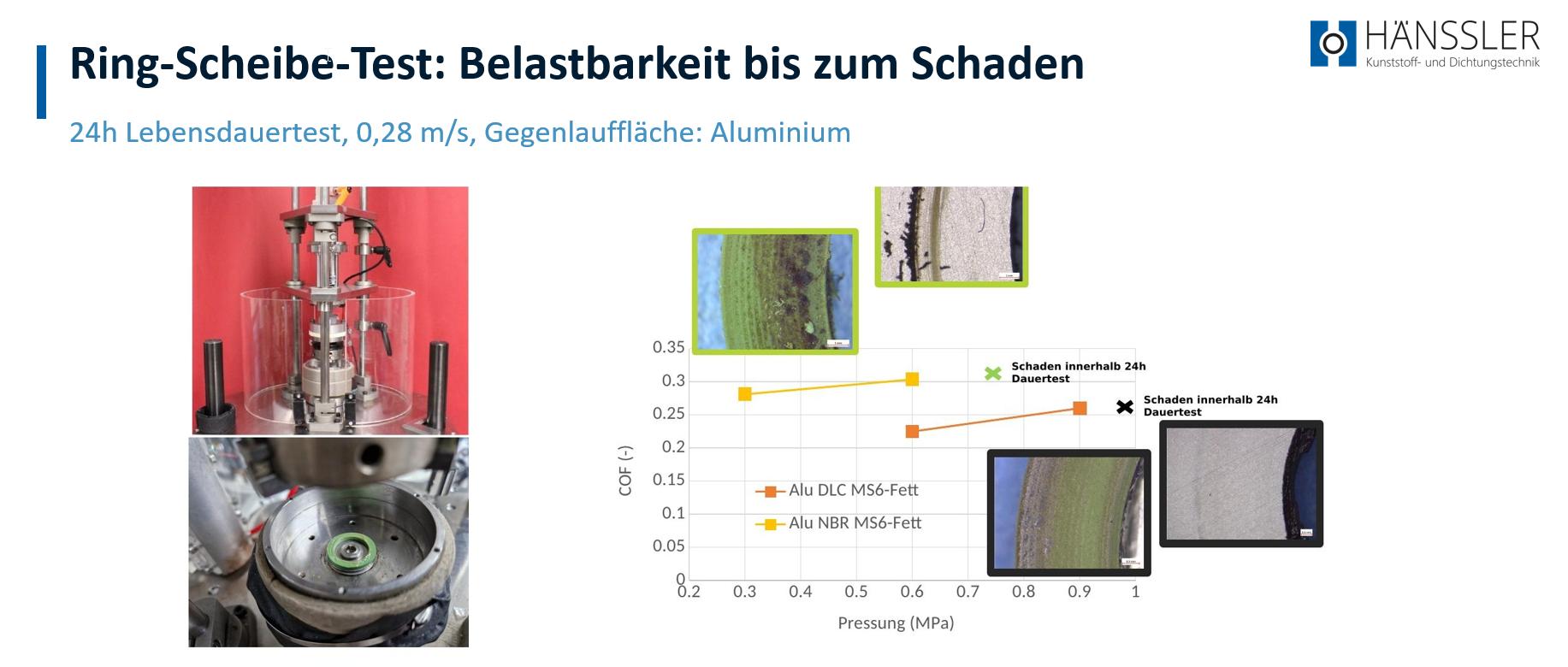
    REM-Untersuchungen an DLC-beschichteten Kunststoffen

    What we also learned in the process

    Not everything works right away. The tests conducted so far have also revealed limitations and boundary conditions that are important for a realistic assessment.

    The DLC coating wears down under high loads. This was to be expected. What is interesting, however, is that the positive effect is partially maintained even after wear. The hypothesis: DLC particles are carried into the mating surface, where they further improve the tribological properties.

    There is a break-in phase. At low speeds, the initial breakaway torque is slightly higher than in broken-in systems. This decreases after the break-in period. Under SEM, the installation of the DLC-coated seals onto the pistons shows that the microstructural layers partially protrude after stretching and relaxation, but do not flake off. The coating thus withstands the installation process.

    When is DLC coating cost-effective?

    DLC coating is not a mass-production process. The seals are positioned individually in trays and coated in a plasma vacuum chamber. This is a targeted process that is more complex than standard coatings. The additional laser structuring, which yielded promising results in the laboratory, is currently not being used in mass production because it is too costly for large-scale manufacturing.

    The coating makes economic sense where the technical advantages outweigh the additional costs in the overall system: fewer failures, longer service life, elimination of lubricants, and compliance with current regulations. Typical use cases include applications requiring dry running, reduced wear, or PFAS-free operation. The switch to water-based lubrication in previously oil-lubricated systems can also be an economic driver.

    Just give it a try

    The DLC coating can be applied directly to existing seals without altering their geometry or material. You don’t need to design a new component. We’ll analyze your application, have your seals coated, and then work with you to plan the testing. Just contact us.

    Color contrast
    Text
    Highlighting content
    Zoom