Turned parts

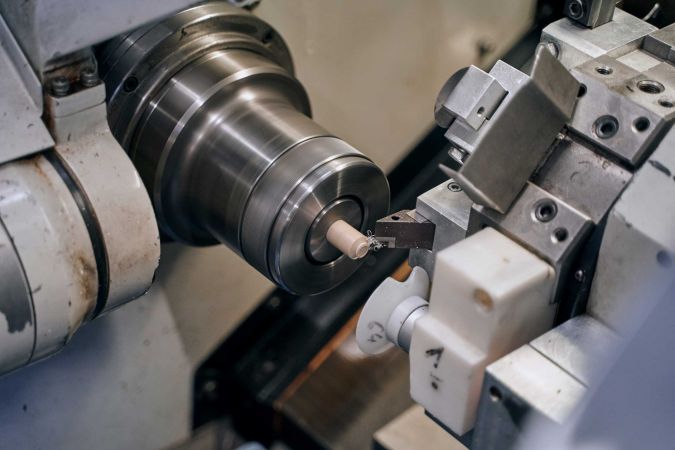
We specialize in processing exclusively technical plastics in our production. We deliberately refrain from processing metals. This gives us the opportunity to optimize our machinery specifically for the machining of plastics. This allows us to apply our expertise in plastics technology directly to plastic turning. As a result, we are able to process high-performance plastics and create complex geometries.
Thanks to this specialization in plastics, we are more than just a contract manufacturer of turned plastic parts; you can also rely on us as a development partner. Our team of experienced engineers supports you with fast communication channels and practical expertise. We recommend contacting our development department at an early stage, even if the material and design have already been decided, since this often reduces costs and further improves component quality.

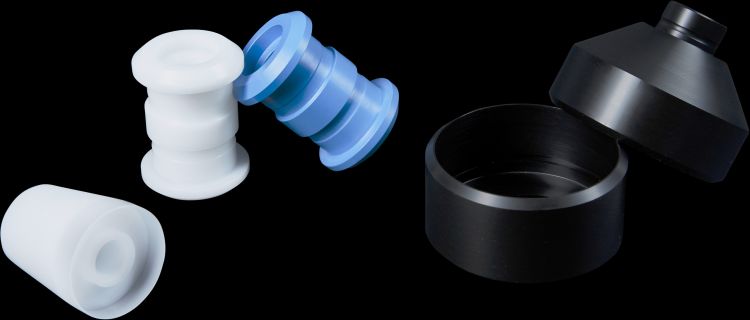
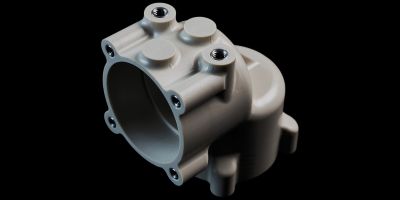
Production of turned parts from PEEK
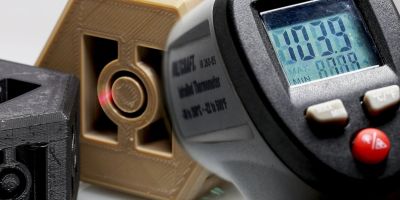
Thermal expansion of turned plastic parts
For many types of plastic, the coefficient of thermal expansion is 20 times greater than for most metals. During turning, friction and thus heat is generated, which is transferred to the workpiece and thus already has a greater influence on the accuracy during production.
This influencing factor must also be taken into account during the quality control of the CNC machines during production, as well as during the final inspection of the components. Our CNC machines are essential to counteract this effect. Heat dissipation via cooling lubricants is not permitted with most high-performance plastics.
Especially when using high-temperature plastics, this high coefficient of thermal expansion must be given essential consideration and the design must be adapted as necessary.

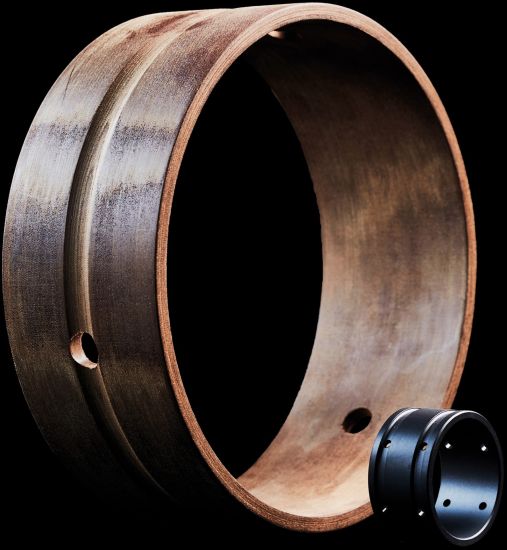
Guide bushes made of hard fabric and POM | Application: mechanical engineering
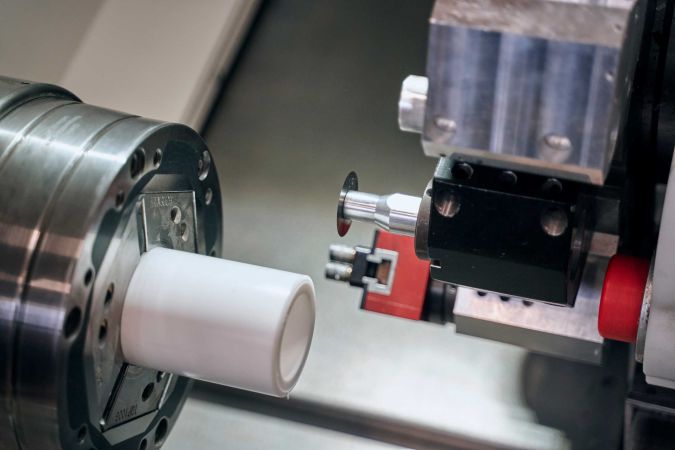
Production of turned parts from PTFE
Tolerancing of plastic turned parts
Precision plastic parts cannot always be produced with the tolerances that are state of the art for metal parts. Plastics processing is much more demanding with the large number of engineering plastics, which is why the tolerances also have to be designed as necessary.
On the one hand, the lower stiffness and greater elasticity play a role, on the other hand, the thermal expansion, which is on average 20 times greater. Added to this is the moisture absorption specific to plastics in many materials.
A decisive factor in plastics technology is residual stresses that can remain in the semi-finished product as a result of production. During machining, they are released and can thus have an influence on accuracy.
For all these challenges, we have developed solutions to still achieve the highest accuracy when machining plastics.
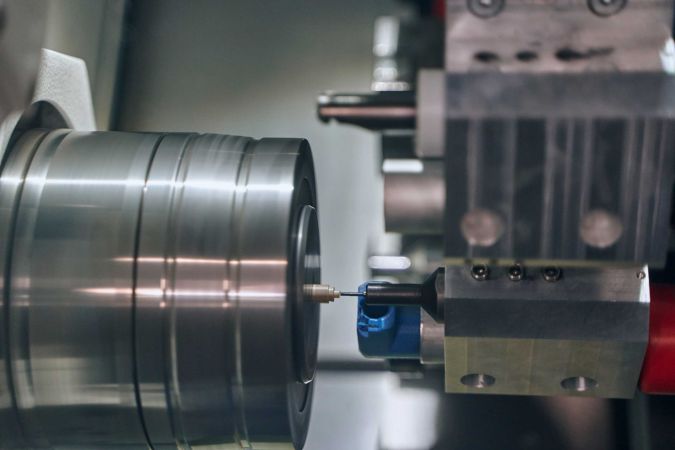
Production of turned parts from PEEK GF
From the smallest diameter to large plastic turned parts
Due to our diverse machinery in the plastic turning department, we are able to manufacture micro components made of plastic as well as the largest turned parts up to 1500 mm. At our location in Mannheim, we cover a very wide range of plastic solutions through many innovations.
Depending on the requirements, we select the ideal manufacturing process and coordinate the processes for an optimal result with our customers.
Residual stresses of turned parts made of special plastics
During the production of semi-finished products from thermoplastics, residual stresses often arise which remain in the semi-finished product due to the cooling process. Without the necessary safety equipment, these residual tensions are released during CNC machine processing and the component can deform. This deformation can continue for a long time after machining. Plastic parts that have been positively measured may suddenly show dimensional deviations after a certain storage time.
At Hänssler, we counteract this effect by reducing residual tensions with our annealing furnaces before processing, or even between processing steps. Thanks to our know-how and many years of experience, we know the annealing processes for standard plastics as well as for high-performance plastics and can therefore realize essential tolerances.
Turned parts made of elastomers
Machining of elastomers
It is difficult to imagine machining elastomers since the material “gives way” and does not behave like metal or other plastics.
However, we can produce elastic turned parts using special blanks and stabilization during the machining process. We embed the elastomer material in resin. This resin stabilizes the part during machining, ensuring dimensional stability.
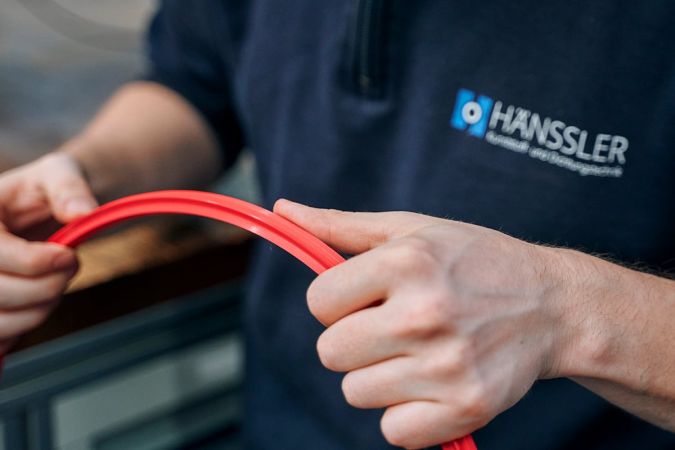
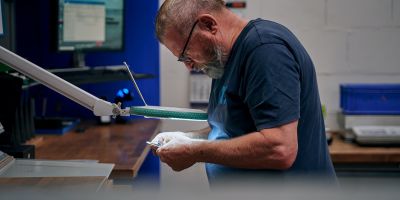
Testing of a turned part made of elastomer
Advantages of machined elastomer parts
- Excellent edge quality: Sharp, defined edges are possible with turned elastomer parts.
- High dimensional and shape accuracy: Stabilizing the blank (resin embedding) achieves highly precise geometry in elastic turned parts.
- Thin-walled components possible: Very small wall thicknesses can be achieved (in some cases only approx. 0.2–0.3 mm). Such thin-walled areas are often much more difficult to achieve with other manufacturing processes.
- Wide range of sizes:Turned parts made of elastomer can be produced from a few millimeters, but also as very large parts – up to approx. 1.5 m in diameter.Fast and flexible without a mold:
- No mold is required for turned parts. This eliminates tooling costs and long lead times. Depending on requirements, parts can be delivered within a few days.
Frequently asked questions about turned parts
When turning plastic, a rotating semi-finished plastic product is clamped in a turning machine and cut with a suitable tool. The materials used, the tools used, the cutting speed, and how the chips are removed are all very different from metalworking: Plastics must be clamped, cooled, and cut properly to avoid problems. If you take these factors into account, you will get plastic turned parts that are clean, have the right dimensions, a good surface finish, and low scrap rates.
For turning plastic, it is best to use a technical thermoplastic that is easy to machine, such as polyamide (PA) or polyoxymethylene (POM). Those with higher requirements (chemicals, temperature, wear) can also use high-performance plastics such as PEEK. However, in this case, special attention must be paid to the machining conditions (heat, tools, residual stresses).
The parts made of PEEK are heat-resistant, chemical-resistant, and mechanically very strong. They also retain their shape. They are especially useful when traditional plastics or metals can’t provide enough strength.
Turned parts made of POM impress with their high strength, rigidity, and toughness. In addition, they have very good sliding and wear resistance combined with low water absorption and good dimensional stability. This makes them ideal for precise, loaded components with sliding or rotational movement as well as for humid or chemically stressed environments. However, their limited high-temperature resistance and limited compatibility with other materials must be taken into account during processing and use.
Turned parts can be requested from Hänssler Kunststoff- und Dichtungstechnik via the contact form, by phone, or by email.