Large plastic components for furniture

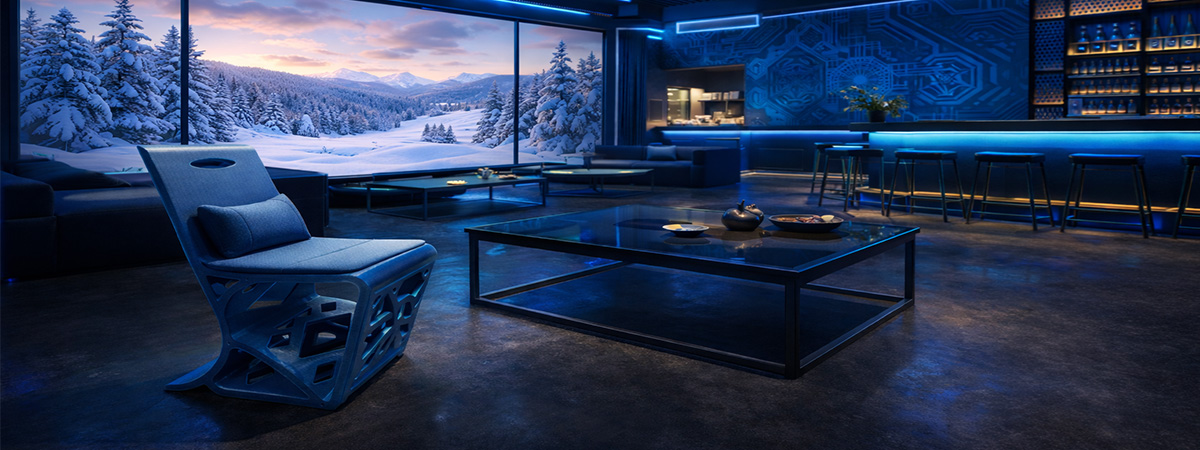
LFAM makes large, customized plastic components for furniture manufacturing economical. Structural components or design components in furniture manufacturing are often very large, and conventional methods of manufacturing large plastic parts are very expensive and often only worthwhile for very large quantities. The alternative is often machined wood or steel components that are assembled as a unit. However, complex lamination processes can also be used. Hänssler manufactures large-format, complex components in a hybrid process that combines 3D printing and machining. This makes it possible to produce large components economically in small quantities.
What is LFAM?
You are seeing a placeholder for Vimeo. Unlocking will share data with third parties.
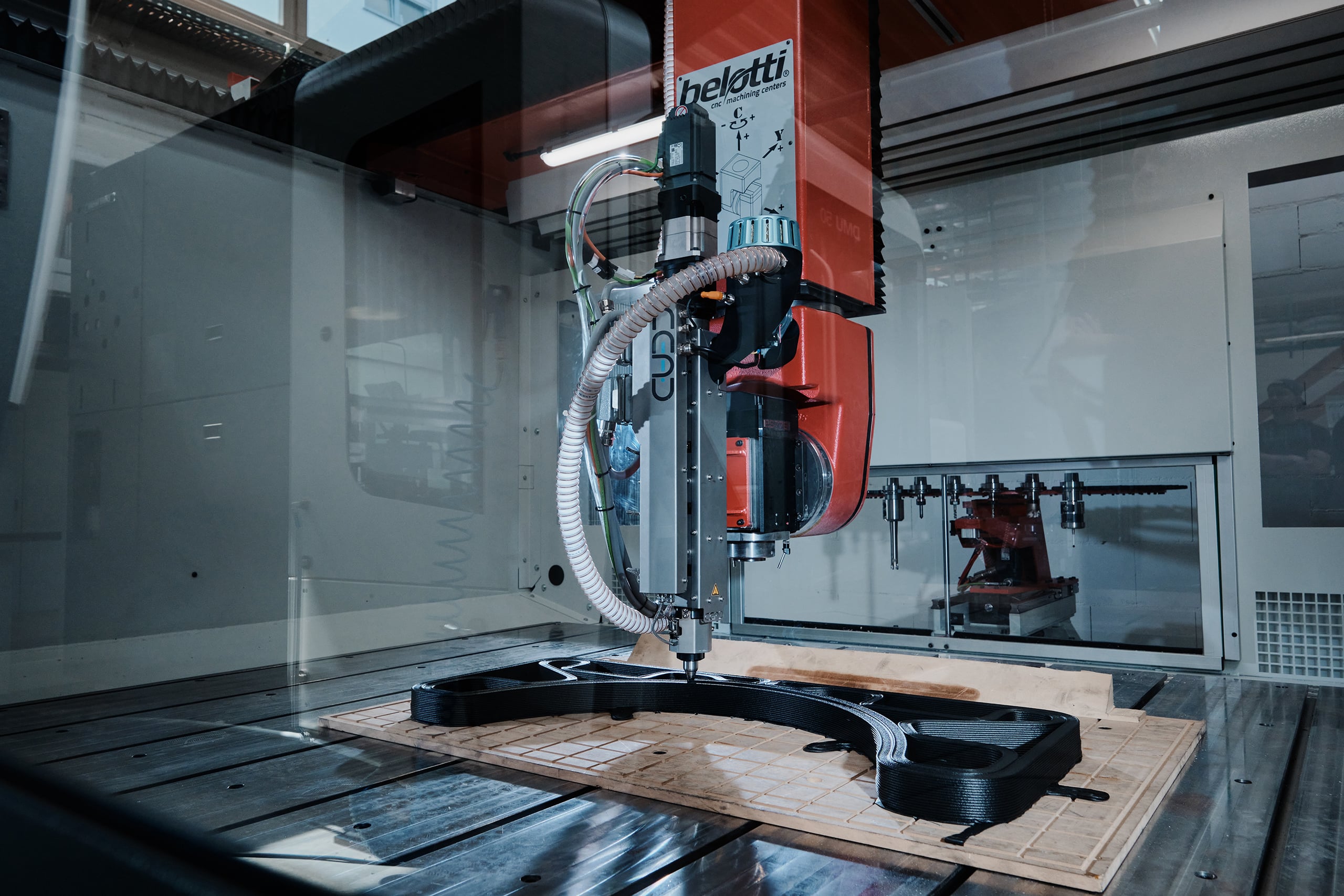
More InformationLarge Format Additive Manufacturing (LFAM) is large-format 3D printing with high material throughput. In our hybrid approach, we combine an extruder head (nozzle diameter up to 20 mm) with a 5-axis CNC milling machine: First, we manufacture components or near-net-shape blanks using the fused deposition modeling process, and then we add functional surfaces, edges, fits, and visible areas with precise CNC post-processing. The build space of 2600 × 1700 × 950 mm allows us to manufacture large-volume furniture components in one piece. This enables us to produce carcasses, support structures, seat shells, counter fronts, wall and ceiling panels, partition elements, or molded parts with integrated fastening and functional zones in a single process.
Advantages of LFAM
The advantages of LFAM lie in the combination of design freedom and manufacturing precision. We manufacture large-format parts without mold casting or welding processes. This enables us to produce personalized variants quickly. CNC post-processing ensures that we achieve consistently reproducible tolerances and high-quality surfaces.
Overall, the combination of 3D printing and machining significantly shortens the development cycle. LFAM also reduces the subsequent assembly effort, as we can integrate functional elements such as cable guides, reinforcement ribs, press-fit seats, clips, assembly aids, or interfaces for fittings directly into the component.
LFAM for furniture construction
Lfam is particularly interesting for furniture construction because it makes mass customization and small-batch production economical. Instead of creating new molds, milling templates, or fixtures, we can manufacture geometrically complex components directly from CAD according to customer-specific dimensions and then bring them to their final dimensions using CNC machining. This makes our LFAM process ideal for special editions, prototypes, and project-related, unique interior fittings, which we have successfully produced to date, particularly for yacht interiors.
In addition, lightweight geometries and fiber-reinforced materials open up new possibilities in terms of stiffness, weight, and component stability. This makes our LFAM products suitable for furniture that is exposed to special conditions, such as chairs for cable car gondolas.
The technology is also ideal for prototypes in the design phase, as iterations can be implemented directly without the need to adapt tools or other aids.
You are seeing a placeholder for Vimeo. Unlocking will share data with third parties.
More InformationWhat materials do we offer?
We use amorphous and semi-crystalline polymers such as ABS, PC, PP, PET, PA6, or PA12 as materials. For higher mechanical requirements, we can reinforce these materials with glass or carbon fibers, which significantly increases stiffness and strength and makes it possible to reliably produce large-area or load-bearing components. Depending on the application, application-specific compounds may also be useful, for example, UV-stabilized, mineral-filled, or flame-retardant variants, as well as colored materials for visible parts.
That is why LFAM should be used for furniture construction.
Furniture manufacturers should consider LFAM products if they want to shorten development times, avoid tooling costs, and efficiently scale product variants. The process is suitable for prototypes as well as pre-series and small series, but also for high-quality, customized end products.
Plastic as a material for furniture construction
Compared to wood and metal, plastic offers a particular structural advantage in furniture manufacturing, namely an exceptionally wide variety of materials. Instead of starting with a relatively fixed set of properties, plastic can be tailored very specifically in terms of material type, additives, and reinforcements. Different materials have different properties, whether flexible or highly rigid, impact-resistant or temperature-resistant, chemical-resistant, or flame-retardant.
| Category | Content |
|---|---|
| Advantage | Very wide range of property profiles: tough, rigid, elastic, temperature- or chemical-resistant |
| Advantage | Variants possible via compounds: UV-stabilized, flame-retardant, mineral-filled, antistatic, colored |
| Advantage | Fiber reinforcement (glass/carbon) enables metal-like rigidity with lower weight |
| Advantage | Function integration through material selection: damping, noise reduction, insulation effect |
| Advantage | Consistent material quality regardless of grain, moisture, or “batch character” as with wood. |
| Advantage | Corrosion-free and highly moisture-resistant without additional protective systems |
| Disadvantage | High-quality appearance and scratch resistance often require a surface concept (texture, paint, film) |
| Disadvantage | Heat and UV behavior must be ensured in terms of design and materials |
| Disadvantage | Sustainability and recycling requirements depend on the material and should be considered at an early stage. |
Small plastic parts for furniture manufacturing
We also produce smaller plastic parts for furniture construction. We offer both 3D printing and subtractive manufacturing. These manufacturing methods also allow the use of materials not previously mentioned.
| Component type | Brief description | Typical quantities | Examples from furniture construction |
|---|---|---|---|
| Turned parts | Rotationally symmetrical parts | Prototype to series production | Furniture legs, knobs, spacers, decorative sleeves |
| Milled parts | Parts with complex geometries | Prototype to small series production | Fronts with recessed handles, body side panels with grooves, bed fitting mounts, recessed hinge pockets |
| Moulded parts | Moulded parts | Series to large series production | Plastic corner connectors, cover caps, roller housings, cable bushings |
| 3D printing | Layered parts | Prototype to series production | Assembly aids/drilling templates, prototype handles, special adapters for fittings, spacer clips |