Top-Innovator 2026 – top100.de

PFAS-free seals

  • Home
  • Sealing Technology
  • PFAS-free seals
  • Wasserstoff Kraftwerk und Solarpanels

    We support you in switching to PFAS-free seals by advising you on sealing solutions, producing seals without PFAS, and conducting research into DLC coating of elastomers.

    What is PFAS?

    PFAS are a large group of fluorinated chemicals. Due to their high chemical stability, they are often referred to as “forever chemicals” because they degrade very slowly in the environment. This poses potential environmental and health risks. A far-reaching ban on PFAS has been under discussion for some time. However, as things stand at present, it is unlikely that a comprehensive ban will be implemented across all applications in the short term. Regardless of this, there is a need for action, particularly with regard to substitutability, supply chain risks, and future regulatory requirements. In the following article, we assess the situation and show practical ways to switch to PFAS-free seals.

    PFAS in sealing technology

    PFAS are used in two areas of sealing technology. Firstly, in sealing elements made from PFAS materials such as PTFE or FKM. Secondly, in process and auxiliary materials such as lubricants, pastes, or release agents, which may contain PFAS.

    PTFE is used in many applications because it offers very favorable tribological properties. It enables low friction and low stick-slip tendency. In addition, PTFE is resistant to a wide range of chemicals and can be used over a wide temperature range. This combination often makes PTFE the robust standard solution in practice, especially for demanding media or critical friction behavior.

    FKM is primarily chosen when, in addition to chemical resistance, a wide operating temperature range and good aging resistance are required. FKM exhibits high resistance in many industrial media, especially to oils, fuels, and numerous chemicals. This makes FKM widely used in dynamic and static applications where conventional elastomers reach their limits.

    As things stand at present, we do not expect a blanket ban on PFAS in sealing technology, as there are certain applications in which the combination of temperature, chemical resistance, and tribology is currently difficult to replace. PTFE in particular cannot yet be replaced in all cases.

    The transition to PFAS-free seals

    PTFE and FKM have often been used in practice because it is possible to do so, not because it is necessary. Both materials are considered to be comprehensive solutions and have therefore often been chosen without the application actually requiring all of their properties. This is precisely where the opportunity for change lies. If individual requirements such as an extreme temperature range or maximum chemical resistance are not present in real-world operation, a clean analysis of the application often makes it possible to replace these materials with PFAS-free alternatives.

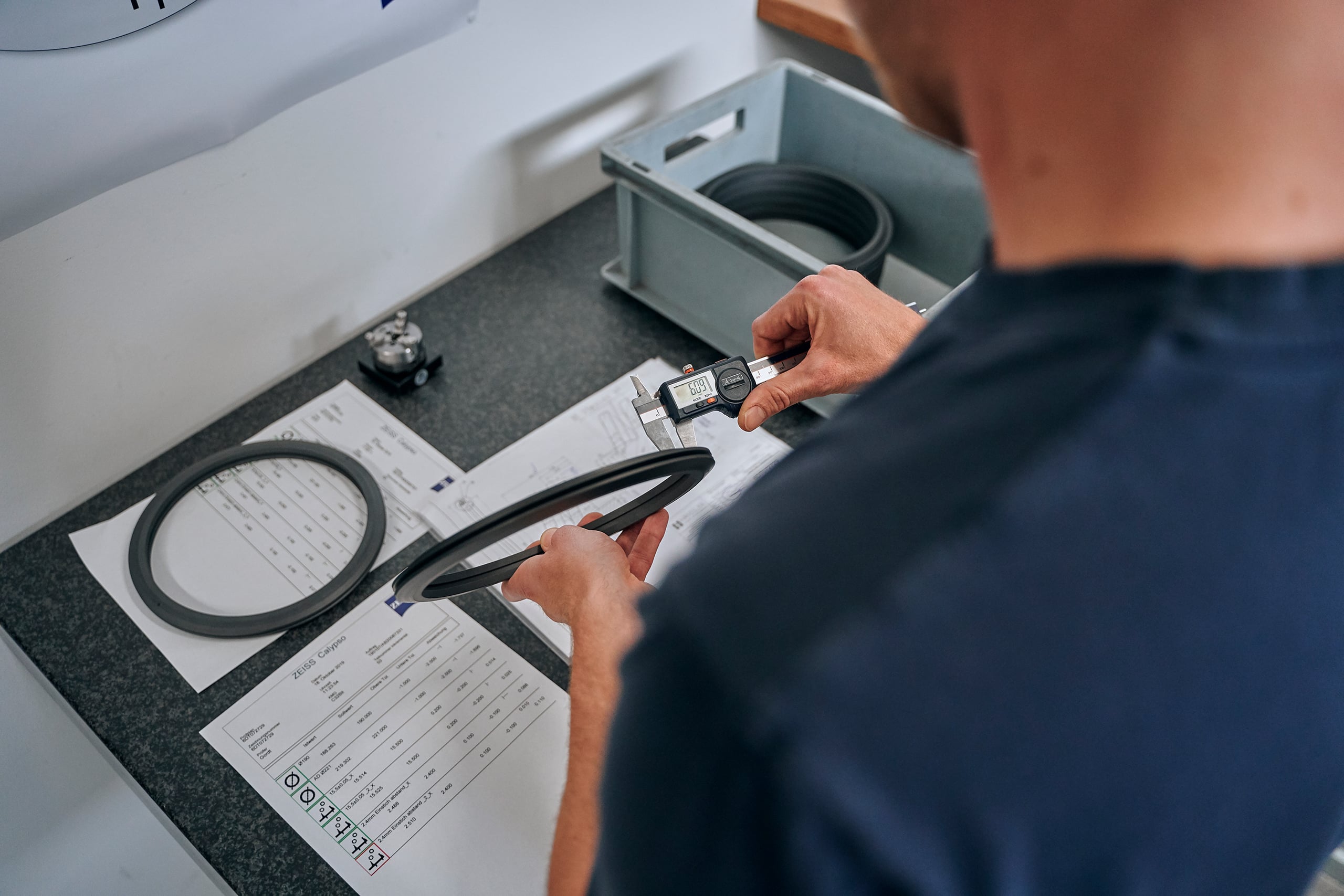
    In some cases, a 1:1 replacement is possible. However, PFAS materials were often chosen to safeguard difficult boundary conditions. In such cases, a simple material change is not sufficient, and a combination of material substitution and system measures is necessary. To this end, we carry out a material and application analysis. Typical test points are:

    • Operating temperature range, including peaks
    • Medium and chemistry, including additives
    • Pressure level and gap dimension
    • Movement and friction requirements, including PV tribology and stick slip
    • Counterpart and surface texture
    • Assembly and installation situation
    Wasserstoff Grafik

    In addition, lubricants containing PFAS can often be replaced by PFAS-free alternatives. This is particularly attractive in the food industry, where there are high requirements for compliance, verification, and risk minimization, and where lubricants can come into contact with product-related areas depending on the application.

    Typical approaches for substitute materials

    1. PE UHMW
      Very low friction and abrasion resistant. It is important to have a clearly defined temperature range and to evaluate creep behavior, frictional heat, and dimensional stability over the service life.

    2. Polyketone
      Interesting if the full performance range of PTFE or FKM is not required. Depending on the medium and temperature, polyketone can provide a balanced combination of strength, wear behavior, and resistance.

    3. Polyurethane materials and TPU
      Robust in dynamic applications, often with good extrusion resistance and stable resilience. The actual temperature, pressure level, gap dimension, and quality of the counter-running surface are decisive factors.

    Deshalb schon jetzt auf PFAS-freie Dichtungen umstellen:

    Supply chains and availability

    The supply chains for PTFE & Co. are expected to weaken in the future because less is being invested in this technology, which will lead to reduced availability and rising prices.

    Regulatory provisions and bureaucracy

    Regulatory pressure is increasing, making verification and documentation significantly more complex and resulting in additional bureaucratic costs.

    Customer acceptance

    Customers increasingly expect products to be “PFAS-free” as a clear purchasing and awarding factor, which is why early conversions create a measurable competitive advantage.

    End of Life

    When components are recycled, this is often done thermally, and if the process is not carried out properly, problematic PFAS chemicals can also be produced from PTFE.

    Elastomers with DLC coating

    Die Hänssler Kunststoff- und Dichtungstechnik GmbH forscht auch im Jahr 2025 an der DLC-Beschichtung von Kunststoffteilen.

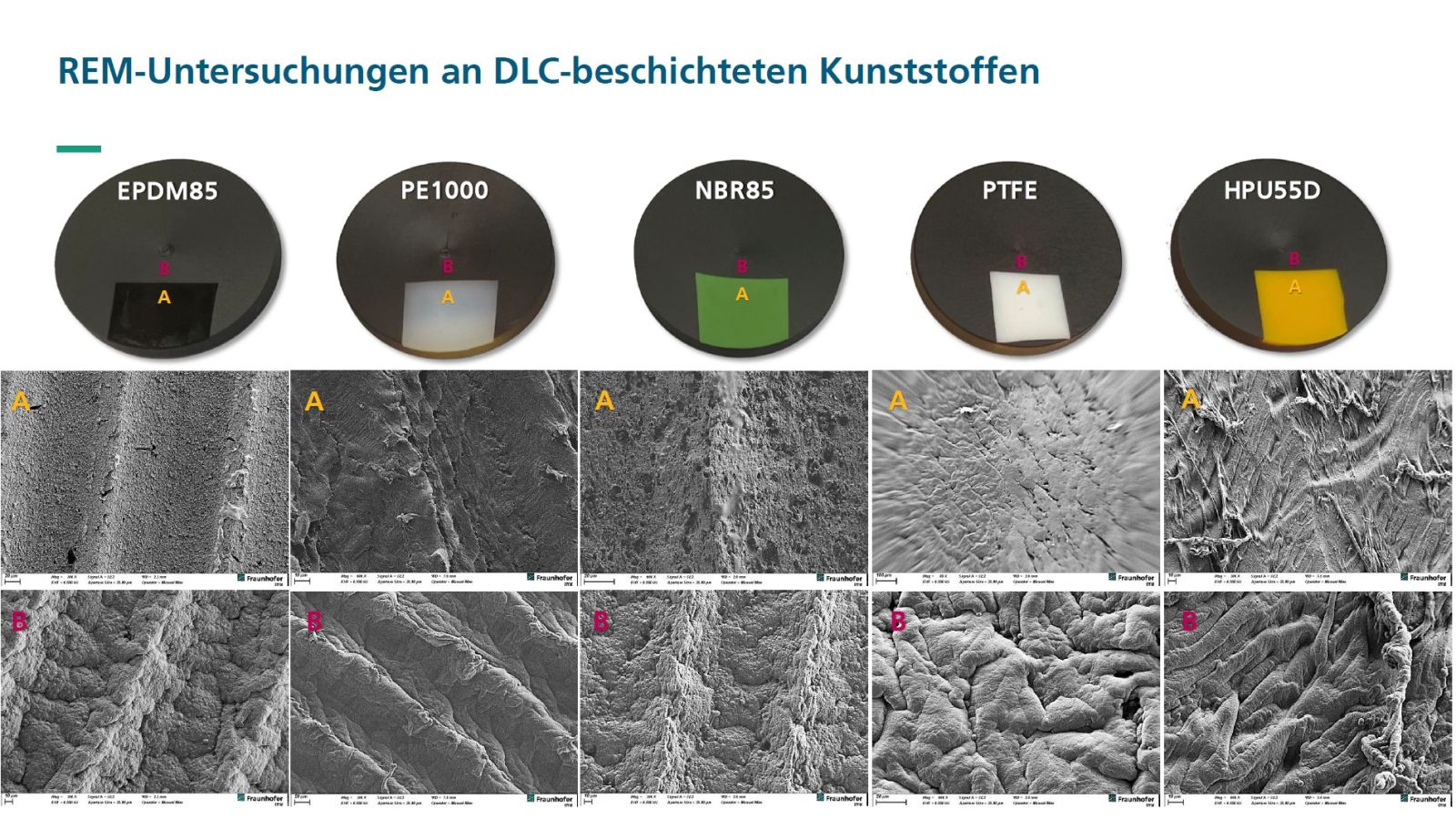
    Together with the Fraunhofer Institute, we are working on a collaborative research project on DLC coating of elastomers. The aim is to enable PFAS-free sealing solutions that function reliably even under demanding friction conditions. The results of this development are already being put into practice. Several customers are conducting trials in technical systems, which in many cases are very successful and show clear potential.

    Elastomers with DLC coating are particularly interesting when PFAS has previously been used primarily to minimize friction or prevent stick-slip. DLC stands for diamond-like carbon. In tribological contact, the coating can significantly reduce friction and heat generation in the contact area. This opens up additional options for lubrication, for example with water-based media, with reduced lubrication, or in selected applications also with dry running concepts.

    How to successfully transition to PFAS-free seals

    Precise application data is crucial for a quick and safe conversion. However, it is not only the material that is decisive, but the technical system as a whole. In order to be able to give a reliable recommendation, we need to understand the application and the boundary conditions in detail. This is best achieved through personal exchange, because a lot of critical information can only be clarified properly in conversation.

    Typical key questions are:

    1. What medium is used, including additives and cleaning media?
    2. What are the actual temperatures, both during continuous operation and at peak times?
    3. What is the pressure and what gap size can be expected during operation?
    4. What are the friction requirements, for example, starting torque and stick-slip behavior?
    5. How is lubrication carried out and what are the lubricant conditions?
    6. How is the counter-running surface designed, including material, hardness, and roughness?
    7. What is the movement and what are the installation and assembly conditions?

    In many cases, it is also necessary to be prepared to test the solution, either under real operating conditions or on test benches. This may seem costly at first. However, those who respond in a structured manner and validate changes at an early stage will reduce future risks and can gain significant competitive advantages as a result.

    Color contrast
    Text
    Highlighting content
    Zoom