LFAM – Manufacturing processes
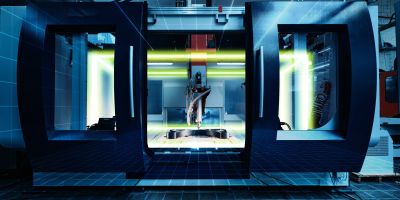
Large Format Additive Manufacturing (LFAM) is a manufacturing process that combines additive and subtractive techniques to produce large scale parts from thermoplastic materials. It is particularly suitable for the production of parts that are difficult to produce using conventional manufacturing methods due to their size or complexity.
Step 1: Materials and process control
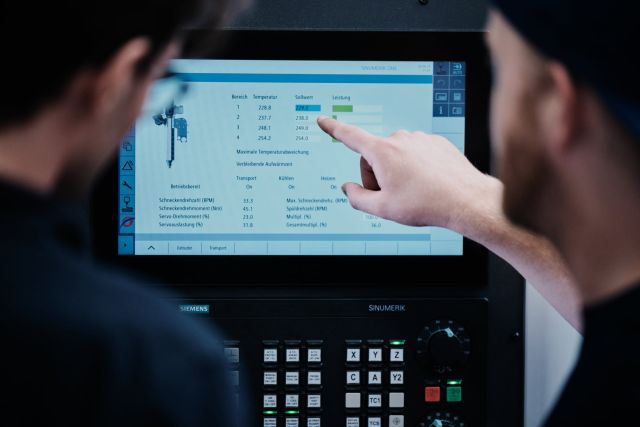
Large Format Additive Manufacturing can process a variety of thermoplastic materials, including high-performance plastics and composites. In Large Format Additive Manufacturing, the choice of thermoplastic material depends on factors such as strength, temperature resistance and chemical resistance. These must meet the requirements of the end product. Throughout the process, parameters such as material temperature, printing speed and the position of the milling tool are monitored to ensure optimum results.
Step 2: Additive manufacturing process
The additive part of LFAM starts with the production of a digital 3D model of the component to be manufactured. This model is then divided into horizontal layers.
Each layer represents a cross-section of the component. The hybrid manufacturing system uses an extruder to extrude the thermoplastic material as a hot, liquid jet. This stream is then applied layer by layer to a build platform, with each layer building on the previous one to form the part.
The thickness of the layer and the speed at which the material is applied can be precisely controlled to achieve the desired shape and quality of the part.
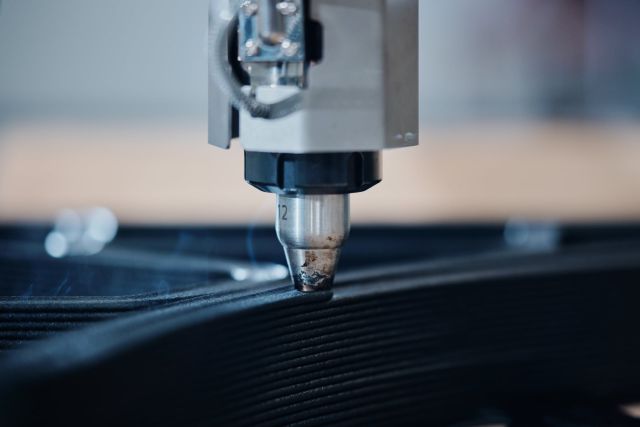
Subtractive manufacturing
After the part has been additively manufactured, the subtractive part of the LFAM process follows. Here, a milling tool is used to remove excess material and achieve the final shape and surface quality of the part. This process is also called “finish milling”. The milling machine is CNC controlled. This allows for high precision and repeat accuracy, which is especially important when producing parts with complex geometries or tight tolerances.
Step 3: Subtractive manufacturing process
Now that the component has been additively manufactured, the subtractive part follows. Subtractive manufacturing is based on the targeted removal of material from a workpiece in order to achieve the desired component geometry and surface quality. This process is also known as “finish milling”. Using processes such as turning, CNC-controlled milling or drilling, tools are used to precisely remove excess material. The result is complex components with defined surfaces and tolerances.
Step 4: Rework
After the subtractive manufacturing process, the part may undergo further rework processes to meet the final specifications and requirements. These finishing steps can vary depending on the specific requirements of the part.
Surface treatment
The surface of the part can be further refined and improved to achieve a smoother surface or specific properties. This can be achieved by various processes, such as grinding, polishing, painting or coating.
Thermal treatment
In some cases, it may make sense to subject the component to thermal treatment in order to improve the mechanical properties of the material. This can serve, for example, to increase the strength or dimensional stability of the component.
Installation
Step 5: Quality management
After post-processing, the component is subjected to a final quality check. This can include a visual inspection, a dimensional check or a test of the mechanical properties. If required, special test procedures can also be carried out, such as non-destructive test procedures or tests using test specimens.
Conclusion: LFAM – the future of manufacturing
In summary, LFAM opens up new frontiers in manufacturing. It combines the advantages of additive and subtractive manufacturing processes and enables the production of large, complex parts with high precision and speed.
It offers a number of advantages, such as reducing material waste, shortening production times and the ability to flexibly implement individual customer requirements.
Frequently asked questions about Large Format Additive Manufacturing (LFAM)
The LFAM process begins with the additive process, in which the material is applied layer by layer to create the rough shape of the eventual component. Then the created blank is machined in the subtractive process, where excess material is removed to achieve the final shape and quality of the component.
LFAM differs from other 3D printing processes in its ability to produce large-format parts from thermoplastic materials. It combines additive and subtractive techniques in a single system, resulting in greater efficiency, precision and quality.
LFAM and Fused Granulate Fabrication (FGF) are both additive manufacturing processes that process thermoplastic materials. The main difference is that LFAM has an additional subtractive component that allows for higher precision and surface quality.
post-processing may be required after the LFAM process to achieve the final surface quality and fit of the part. This may include removing support structures, smoothing the surface or applying surface coatings.