 Scrapers
 Rod seals
 Piston Seals
 Guide rings
 Back-Up rings
 O-Rings / X-Rings
 Flat seals
 Spring-loaded seals
 Radial shaft seals
 Rotary seals
 High pressure seals
 Sealing sets
 O-ring measuring towers
 Turned parts
 Milled parts
 Turned and milled parts
 Bushes or bearings


 Large format 3D printing
 Post-processing of 3D printed parts
 Heat-resistant 3D printed components
 Plastic Components with Flame Retardancy





Guide Element
Definition and Distinction from the Seal
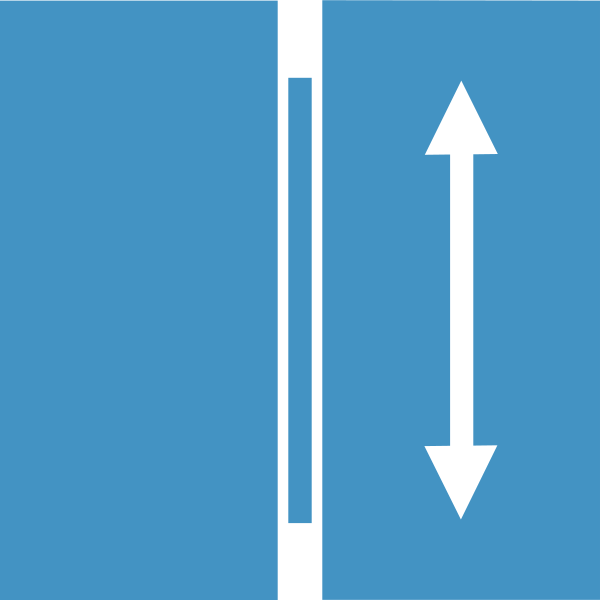
A guide element (also called a guide ring or guide strip) is a wear-resistant sliding element in hydraulic and pneumatic cylinders that radially guides the piston and/or piston rod. It sits as part of the guidance and sealing system in the cylinder, usually in its own groove. Its task is mechanical: it keeps components centered, supports side loads, and stabilizes the running motion.
In sealing technology, this distinction matters because guide elements do not take over pressure sealing. The sealing elements (e.g., the piston seal or rod seal) generate the sealing effect against the medium. Guide elements nevertheless act directly on the sealing function, because they prevent metal contact, control the running clearance (the radial gap between moving parts), and thereby reduce tilting. As a result, friction peaks, score-mark formation, and the risk that seals wear out prematurely under unfavorable loading all drop.
Main Tasks in Operation
In a cylinder, primarily axial forces (in the direction of motion) act, yet in many applications transverse forces appear in addition. They arise, for example, from side loads at the attachment, from long overhangs, from tolerances, or from dynamic tilting. The guide element then works like a plain bearing: it absorbs the transverse forces and distributes them across a defined guide surface.
Without sufficient guidance, surface pressure rises sharply at certain points, frequently at edges. This encourages edge loading at sealing lips, raises friction, and can change the clearance such that sealing material is more easily pushed into the gap. In practice, this often shows up as fast seal wear, uneven running, or rising leakage.
| Function | What happens in operation? | Benefit for the sealing system |
|---|---|---|
| Radial guidance | Centering of piston/rod | Stable running clearance, less tilting |
| Absorption of transverse forces | Support under side loads | Lower edge loading on seals |
| Protection of the mating surface | Avoidance of metal-on-metal | Fewer score marks, lower leakage risk |
| Tribological effect | Controlled friction pairing (sliding) | Smooth running, fewer friction peaks |
Installation Locations and Designs (Ring vs. Strip)
Guide elements are installed where transverse forces are introduced into the system and where stable guidance has to secure the running clearance. They frequently sit on the piston as piston guidance, or in the cover/rod-guide area as rod guidance. Which position is chosen depends on whether the piston in the cylinder tube or the piston rod in the guide area mainly needs to be guided.
Among the designs, guide rings and guide strips (also called wear bands) are mainly distinguished. A guide ring is a closed or split ring with defined geometry. A guide strip is usually cut to size, frequently split, and inserted into the groove, where it adapts to the diameter. The split simplifies assembly, yet it can require an orientation when the main load comes from a preferred direction.
- Guide ring: dimensionally stable, defined butt geometry, often used for standardized grooves and repeatable assembly.
- Guide strip (wear band): flexible in length, well suited for large diameters or for repair/assembly-friendly designs; the butt joint is a constructive point to consider.
Materials and Selection Criteria
Materials for guide elements are selected based on tribological and mechanical criteria. Tribology describes friction and wear in contact. Relevant aspects are stiffness, wear resistance, temperature and media resistance, and creep (time-dependent plastic deformation under load). In addition, mating surfaces (e.g., hardened steel, coatings) and the cleanliness of the medium influence service life.
PTFE composites (PTFE = polytetrafluoroethylene) are widespread, because they offer low friction and high chemical resistance. Pure PTFE, however, can tend to cold flow under sustained load; therefore, fillers such as glass or carbon fibers are frequently used to improve load capacity and wear behavior. POM (polyoxymethylene) is stiffer and is often used for guide rings, including in reinforced variants. PA (polyamide) is tough and robust and is used in some designs as an alternative, sometimes for larger geometries. Fabric- or fiber-reinforced composites offer high load capacity and are interesting for pronounced side loads.
Important selection questions are: which medium runs in the cylinder (hydraulic oil, water hydraulics, fire-resistant fluids)? Which temperature is to be expected? How high are transverse forces, and how long is the guidance? And how clean is the environment — that is, how likely are particles that act as abrasives?
Compact: When Which Material Type?
| Material type | Strengths | Typical application focus |
|---|---|---|
| PTFE composite (filled) | Very low friction, good chemical/temperature resistance | Wide range of media, demanding friction situations |
| POM (also reinforced) | High stiffness, good dimensional accuracy | Robust standard guidance, defined geometry |
| PA | Tough, mechanically tolerant | Robust applications, sometimes larger dimensions |
| Fabric/fiber composite | Very high load capacity, good wear behavior | High side loads, demanding guidance |
Benefit, Typical Failure Patterns, and Design Note
The benefit of guide elements often shows up indirectly: they extend the service life of seals, because the sealing lip is loaded more uniformly and the motion axis stays stable. When piston or rod runs skewed, local pressure peaks arise that raise friction and abrasion. At the same time, the risk grows that sealing material is pushed into an unfavorably large gap, which accelerates wear.
Failure patterns in practice are therefore often well interpretable. Score marks on the rod or cylinder bore indicate metal contact or particles in the system, frequently in combination with insufficient guidance or worn guide elements. Surprisingly fast seal wear despite a correctly chosen seal can point to too short a guide length, too small a guide surface, or underestimated transverse forces. Uneven wear around the circumference is also a hint at tilting.
From a design perspective, guide elements must fit into the groove geometry and the overall system of seal and guidance. For cylinders, standards and established design rules exist for housing and groove dimensions of reciprocating sealing systems; the guidance is considered geometrically and functionally within these rules, so that running clearance, installation space, and assembly are reliably mastered.
For complex load cases or unusual media conditions, specialized design can be sensible, because guidance and seal interact closely in operation.


