Top-Innovator 2026 – top100.de
Icon o-rings

O-rings and X-rings – Static seals

  • Home
  • Sealing Technology
  • O-Rings / X-Rings
  • What are O-rings and X-rings?

    O-rings can be used as static seals or in a dynamic sealing system, there they can perform a wide range of functions: like serving as a preload element. Another typical field of application for O-rings is that they are inserted into a groove between two components and elastically compressed during installation.

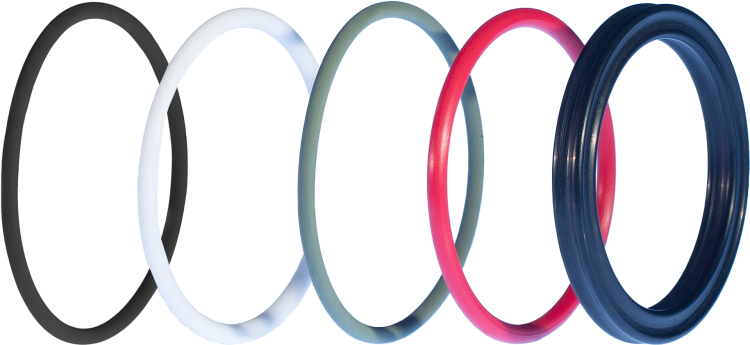
    Because of their many fields of application, O-rings are among the most frequently used sealing elements. Their design is relatively simple: they are annular and have a circular “O” cross-section, hence the name O-ring. Despite their simple structure, O-rings play an essential role in the safety of technical systems. It was O-rings embrittled by the cold that led to the Challenger disaster.

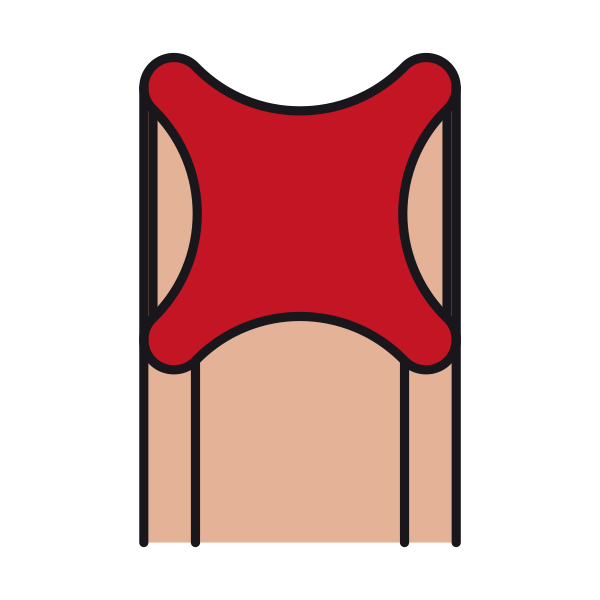
    In contrast to O-rings, X-rings have an X-shaped four-lip cross-section and two sealing lines per side. Due to this geometry, they achieve a high sealing effect even at lower compression, generate less friction, are less prone to twisting in the groove, and, thanks to the lubricant pockets between the lips, can operate with reduced wear under dynamic motion.

    Our offer

    Hänssler trades O-rings and X-rings in many different sizes and materials, whereby we do not manufacture the standard sizes ourselves, but predominantly source them from long-standing partners.

    Our own production is focused on turning special dimensions and special materials, and in this we support our customers already during the development phase.

    Our extensive stock enables us to respond flexibly and at short notice to customer requirements, which is why we also offer an express service. Overall, we reliably supply both standard sizes and custom-made products.

    Choosing the correct O-ring / X-ring

    The more information is known, the better a sealing system can be adapted to a specific application.

    To choose the right O-ring and the optimal material, the following criteria are important:

    • installation space
    • pressure range
    • temperature range
    • medium
    • stroke speed
    • counterface
    • friction behavior
    • tightness
    • price
    • availability

    Frequently Asked Questions about O-rings and  X-rings

    Where does the name O-ring come from?

    The term O-ring refers to the circular shape of the sealing element: the “O” describes the round cord diameter (cross-section), which is reminiscent of the letter O.

    From which materials are O-rings and X-rings manufactured?

    O-rings and X-rings are predominantly manufactured from elastic materials, in particular from NBR, H-NBR, EPDM, FPM/FKM, FFKM, silicone, and PU. For special requirements FEP-encapsulated versions are additionally used. X-rings generally use the same material groups as O-rings.

    What is the difference between an O-ring and an X-ring?

    O-rings have a circular (O-shaped) cross-section, whereas X-rings have an X-shaped four-lip cross-section.

    What are the advantages of X-rings?

    X-rings are more complex in design and generally more expensive than O-rings, but in many dynamic applications they provide more reliable sealing with lower friction and higher operational stability.

    Where can I buy O-rings and X-rings?

    O-rings and X-rings can be requested from Hänssler Kunststoff- und Dichtungstechnik via the contact form, by phone, or by email. In addition to standard profiles, Hänssler specializes in manufacturing custom profiles and can use high-performance plastics for demanding applications.

    Color contrast
    Text
    Highlighting content
    Zoom